The Shoulder
instability
Static factors (stability through inert structures)
Joint surfaces
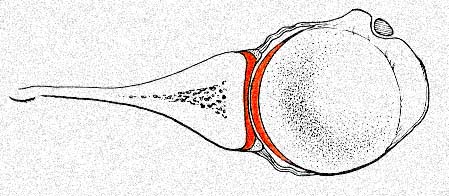
The glenohumeral joint is a ball-and-socket joint: concave glenoid articulates with the spherical head of the humerus.
Only 25% to 30% of the humeral head is covered by the glenoid surface.
Recent studies have demonstrated that, though the bony surfaces of the joint are largely incongruent (flat glenoid and round humerus), congruence is restored by the difference in cartilage thickness.
Glenoid cartilage was found to be the thickest at the periphery and thinnest centrally, whereas humeral articular cartilage was thickest centrally and thinnest peripherally.This leads to a merely uniform contact between humeral head and glenoid surface throughout shoulder motion.
Glenoid Labrum
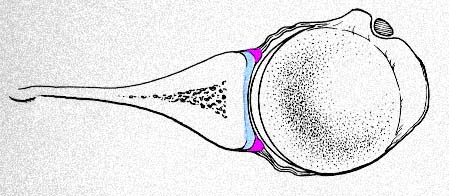
The labrum is a fibrous structure that forms a ring around the periphery of the glenoid and acts as an anchor-point on the glenoid for the capsulo-ligamentous structures.
It contributes to stability by increasing the depth of the glenoid socket.
Recent studies have suggested that the labrum may also contribute to stability by increasing the surface area and acting as a load bearing structure for the humeral head.
Cohesion Adhesion
There is minimal (less tan 1 cc) free fluid in the normal shoulder joint. The normal shoulder is sealed by the capsule so that outside fluid cannot enter it. Viscous and intermolecular forces prevent ready fluid motion and provide a cohesive bond between between glenoid and humerus. This is called the adhesion-cohesion mechanism (to compare with the two wet microscope slides pressed together) and is a very strong stabilizing factor.
Furthermore, the slightly negative intra-articular pressure creates a vacuum that pulls the humerus against the glenoid.
So: As long as the joint remains a closed cavity, containing a limited amount of free fluid it will be extremely difficult to separate both articular surfaces.
Capsule and Ligaments
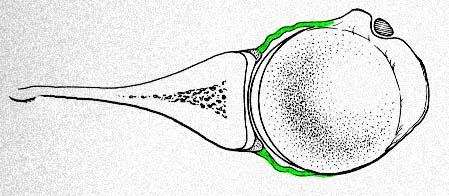
The joint capsule is large, loose and reduntant (the capacity of the glenohumeral joint capsule is larger than that of the humeral head to allow full and free range of motion of the shoulder.
Capsule and ligaments cannot prevent glenohumeral translation when the joint is in most of its range - capsular ligaments are only under tension at the end range of motion.
The capsule is reinforced by three anterior and inferior ligaments.
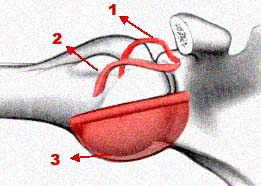
- the superior gleno-humerale ligament
- the middle gleno-humerale ligament
- the inferior gleno-humerale complex.
Recent studies show that the main importance of the capsule for the stability of the shoulder lies in the feed-back mechanism of the proprioceptive innervation and contraction of the rotator cuff.
| [Start] | [Main shoulder] | [Flowcharts shoulder] | [A System of Orthopaedic Medicine] |
Copyright © 2021 DR. L. OMBREGT All Rights
Reserved
The author can not be held responsible for any damage caused by the use of any information provided.