The Shoulder
Help - Examination
You find a pattern that deviates somewhat from the usual ones.
- There is only a minor but painful limitation of the passive medial rotation.
Minor but painful limitation of the passive medial rotation as the only positive test ( the other passive tests being full range and painless and the resisted tests strong and painless) usually indicates a Chronic 'Adhesive' Bursitis.
- There is only a minor but painful limitation of the passive elevation.
A minor but painful limitation of the active as well as of the passive elevation in the absence of other positive tests (the passive lateral- en medial rotations being full range and painless and the resisted movements strong and painless) usually point in the direction of a Chronic 'Adhesive' Bursitis.
- There is a capsular pattern in combination with positive resisted movements.
A capsular pattern in combination with one or more positive resisted tests can be somewhat confusing. It is possible that the thightening of the rotator-cuff muscles (2) which also partly insert in the fibrous capsule and strenghten it, irritate a severely inflamed synovia (1).
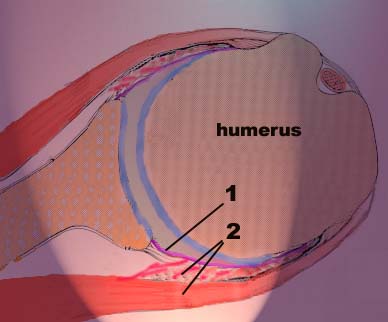
Thus in a severe arthritis (Acute stage), the resisted tests may somewhat increase the pain. In this case, the positive resisted tests will not indicate a contractile lesion but are considered as 'transmitted stress' to the inflamed capsule. One should then completely concentrate on the treatment of the capsular pattern and with the improvement of the situation, the resisted movements will usually become negative as well. - There is a non capsular pattern in combination with positive resisted movements.
A minor but painful limitation of the medial rotation or of the elevation, in combination with one or more painful resisted movements (usually abducton and/or lateral rotation) should be considered as signs of a Chronic 'Adhesive' Bursitis.
A minor painful limitation of the passive elevation or of the medial rotation in combination with a weak ( and painful) resisted abduction and -lateral rotation should be interpreted as signs of an extensive rotator cuff lesion; The limitation of the passive movements may be caused by the considerable accumulation of fluid in the subacromial space. Of course, also the active elevation is thoroughly limited if the rupture of the supraspinatus is complete.
| [Start] | [Main shoulder] | [Flowcharts shoulder] | [A System of Orthopaedic Medicine] |
Copyright © 2021 DR. L. OMBREGT All
Rights
Reserved
The author can not be held responsible for any damage caused by the use of any information provided.